

Let’s get one thing straight from the jump: this isn’t our father’s era Gulf War. There will be no “Highway of Death” footage looping on CNN. No triumphant general standing on the deck of an aircraft carrier under a “Mission Accomplished” banner. No Saddam statue getting toppled in Tehran’s squares.
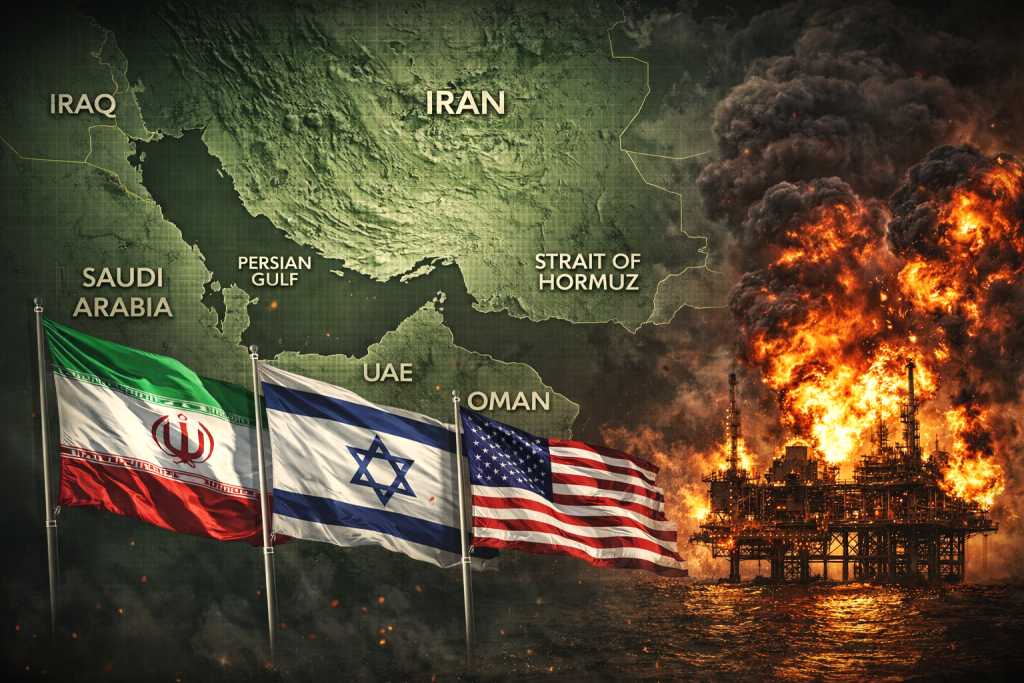
What we’re witnessing in the Strait of Hormuz right now is something far more terrifying for the Pentagon, far more humiliating for Tel Aviv, and far more instructive for the rest of the world.
Iran is losing every battle but winning the war. And the United States? America isn’t losing to Iran—America is losing to itself, to its ally Israel, and to a new math of warfare that $2 trillion Pentagon budgets still don’t understand.
The numbers don’t lie. But the people releasing them? They lie constantly. More on that later.
Strap in. This is Sun Tzu meets Silk Road logistics with hypersonic missiles, and the body count includes American global dominance.
I. THE STRATEGIC FRAMEWORK: Why Iran Cannot Lose
Before we dive into the kill chains and casualty figures, we need to establish the fundamental truth that every NATO strategist missed: for Iran, this is a war of survival. For America, this is a war of choice.
When you’re fighting for survival, you don’t need to win every engagement. You don’t need to hold every city. You don’t even need to protect every leader. You just need to not lose. You need to make the cost of your annihilation higher than the other side is willing to pay.
And right now, despite the assassination of Supreme Leader Ayatollah Ali Khamenei on February 28 [2], despite the strikes on Kharg Island that handle 90% of Iran’s oil exports, despite more than 15,000 targets hit across the country according to US and Israeli officials [8]—Iran is very much not losing.
The New Supreme Leader Problem for the West:
Here’s something the White House didn’t calculate: when you kill an 85-year-old Supreme Leader, you don’t decapitate the regime. You just promote his son. Mojtaba Khamenei, 56, was announced as the new Supreme Leader within days [1]. The Assembly of Experts met. The succession happened. The regime didn’t collapse.
Was he actually in that bunker strike on February 28? President Trump admitted this week he doesn’t know: “We don’t know their leaders,” he told reporters [10]. That’s not intelligence. That’s guesswork.
But here’s what matters: the structure held. And this week, the new Leader’s government made clear there will be no quick end. Mojtaba Khamenei has rejected all ceasefire proposals conveyed to Iran’s Foreign Ministry, declaring it is not “the right time for peace until the United States and Israel are brought to their knees, accept defeat, and pay compensation” [9]. That’s not a dying regime. That’s a regime digging in.
The Larijani Assassination Changes Everything:
On March 17, Israel confirmed it had killed Ali Larijani, secretary of Iran’s Supreme National Security Council and one of the country’s most powerful figures [2][3][8]. Larijani died alongside his son and his deputy, Alireza Bayat [9]. He was described as the regime’s “principal figure for survival strategy, regional policy, and defence coordination” [4]. More importantly, he was “the only man, who, during non-war times, favoured ‘talks'” [5].
Trita Parsi of the Quincy Institute put it bluntly: Israel is “systematically eliminating Iran’s pragmatists — the figures most capable of building internal consensus for a negotiated exit” [5].
Also confirmed killed: Gen. Gholam Reza Soleimani, head of the Revolutionary Guard’s Basij militia [2][3].
The Analyst Verdict
Belarusian political scientist Nikolai Platoskin summarized the strategic reality: “They expected that they killed the leadership, and enthusiastic crowds would take to the streets, sweeping everyone out of institutions, ushering in freedom and democracy. It turned out the opposite. That was the first miscalculation. Trump admitted it. And crucially, he cannot explain a simple thing to people: what is the goal? What do they even want?” [1]
Russian analysts concur: “The Iranian elites have no incentive to make concessions. In the face of military pressure and the threat of physical elimination, they have ‘nothing to lose,’ so one cannot expect them to voluntarily retire from power or accept American conditions” [5].
With Larijani’s death, the exit route is virtually shut, as the Strait of Hormuz is [5].
II. THE BEIDOU BOMBSHELL: How China Broke America’s GPS Monopoly

Here’s where the technical defense analysis gets interesting—and where the Pentagon’s $2 trillion investment in GPS superiority starts looking like the world’s most expensive paperweight.
The Precision Problem, Circa 2025:
Remember the June 2025 conflict? The 12-day war? Iran fired missiles. Lots of them. But they couldn’t hit the broad side of a desert. Why? Because America turned off the GPS, and Iran was flying blind with civilian-grade signals that the US could degrade, spoof, or shut down at will.
That was then. This is now.
Sometime in the eight months between June 2025 and February 2026, the Iranians did something that should terrify every US Central Command planner: they completely disconnected from GPS and migrated their entire military guidance architecture to China’s BeiDou-3 satellite constellation.
What Is BeiDou?
Let’s break this down technically.
BeiDou (北斗) is China’s answer to GPS. But it’s not just “the Chinese GPS.” It’s better. Here’s the spec sheet:
· Satellites: 56 in orbit (GPS has 31) [4]
· Ground stations: 120 (GPS has 11) [4]
· Coverage: True global coverage with higher density over Asia and the Middle East
· Kill Switch: None that the White House can flip
The Hardware Proof:
What got hit tells the story. According to multiple reports, Iranian strikes have taken out:
· A THAAD system’s radar in Jordan [4]
· A PAVE PAWS early warning radar in Qatar [4]
· CIA facilities at the US embassy in Saudi Arabia, with some buildings “beyond repair” [4]
· Energy infrastructure across the UAE, including Fujairah—hit again on March 17 and 18 [3]
· Saudi Arabia’s Ras Tanura refinery [4]
You don’t hit THAAD radars with blind luck. You hit them with precision. And precision requires satellite guidance that the enemy can’t switch off.
III. THE UNDERGROUND EMPIRE: Iran’s Missile Cities and Drone Armada
Let’s talk hardware. Because while the US and Israel are burning $3 million interceptors to stop $20,000 drones, Iran is running the most efficient military economics lesson since the JF-17 made the Rafale cry.
The Numbers Game:According to military intelligence assessments before the war, Iran had stockpiled:
· Ballistic missiles: 2,500 to 3,000 operational, including 2,000 medium-range ballistic missiles [5]
· Launch vehicles: 400 to 480 mobile Transporter-Erector-Launchers (TELs)
· Attack drones: 2,000 to 5,000, mostly Shahed-series [5]
· Cruise missiles: Hundreds, with low-altitude terrain-hugging capability
After 19 days of the most intense bombing campaign since the Iraq War, here’s what’s remarkable: Iran is still launching. On March 18, Iran launched multiple-wave attacks targeting Tel Aviv with multi-warhead missiles, Saudi Arabia’s Eastern Province, Kuwait, Bahrain, Qatar, and the UAE [2][3][4]. An Iranian official claimed that only 43% of Iran’s stockpile has been wiped out [3]. That means 57% remains.
The Missile Cities:
How? Underground, that’s how.
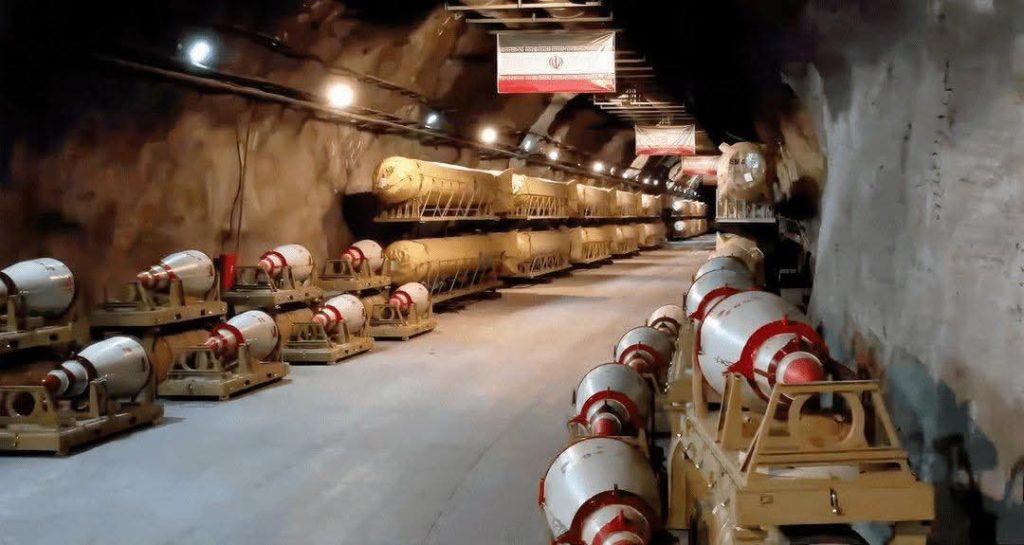
Iran has spent two decades building what it calls “Missile Cities”—deep underground bunker complexes carved into mountains, with production facilities, storage depots, and launch rails [5]. On March 2, the IRGC publicly released footage of one such facility: a long tunnel with no visible end, lined with numerous Shahed-136 drones and missiles [5].
The Fleet:
Let’s break down what’s actually in the air.
Shahed-136: The AK-47 of the Skies
· Cost: Approximately $20,000 [9]
· Range: 2,500 km [7][9]
· Warhead: 30-50 kg [7][9]
· Speed: 185 km/h [7]
· Length: 3.5 meters [7]
· Wingspan: 2.5 meters [7]
· Engine: MD550 (copy of Limbach L550) [7]
· Role: Saturation attack, infrastructure targeting, psychological warfare
The Shahed isn’t sexy. It’s not stealthy. It’s not hypersonic. What it is, is everywhere. Launched from the back of military trucks, these “loitering munitions” have become the signature weapon of this conflict.
The Math Problem:
Iron Dome interceptors cost $40,000–$50,000 per shot [9]. David’s Sling interceptors? $1 million [5]. Arrow-3? $3 million [9]. Standard surface-to-air missiles from Patriot batteries? $2-4 million.
When Iran fires 100 Shaheds in a single wave, the math is:
· Iran’s cost: $2 million
· Defender’s cost: $100 million–$400 million
That’s not warfare. That’s bankruptcy with explosions.
The Heavy Hitters:
But the Shaheds are just the appetizer. The main course is ballistic.
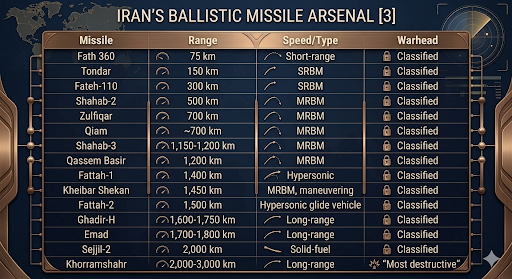
Iran’s Ballistic Missile Arsenal [3][9]:
Khorramshahr-4 and Qadr: The New Threats
On March 18, Iran’s Revolutionary Guard confirmed it launched Khorramshahr-4 and Qadr multiple-warhead missiles to avenge Larijani’s killing [2]. These missiles release cluster munitions over their targets, increasing the chance of evading missile defense systems and overwhelming radar tracking systems [2]. AP footage showed at least one missile releasing cluster munitions over Israel [2].
Fattah-2:
The Hypersonic Wild Card
· Range: 1,500 km [3]
· Speed: Hypersonic glide vehicle
· Guidance: Maneuvering re-entry vehicle
The Fattah-2 represents something far more dangerous than traditional missiles: the hypersonic glide vehicle. Unlike ballistic missiles that spend most of their flight in predictable arcs, the Fattah-2 maneuvers during re-entry at speeds where even hitting it with an interceptor is like trying to shoot a bullet with a bullet—while both are moving at Mach 5+.
Operational Status: Iran claims to have deployed it in this conflict. The US hasn’t confirmed intercepts. That silence is deafening.
IV. THE ECONOMIC WEAPON:
How the Strait of Hormuz Became Iran’s Aircraft Carrier
Now we get to the real battlefield—the one that matters.
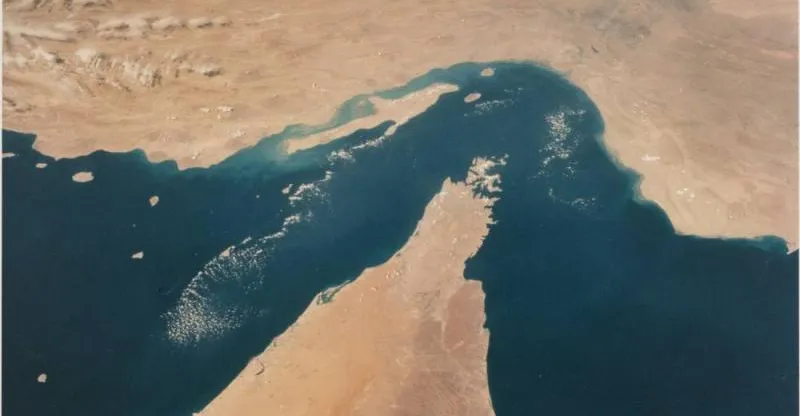
The Strait of Hormuz is 21 nautical miles wide at its narrowest point. Through it flows 20% of the world’s oil and 25% of its liquefied natural gas [1][10]. Roughly 20 million barrels of oil—worth nearly $600 billion annually—pass through every day when things are normal.
Things are not normal.
The Traffic Collapse—and Selective Thaw:
Marine tracking data from the war’s first week told the initial story: tanker traffic through the Strait dropped to zero by March 3 [2].
But on March 18, Iranian Parliament Speaker Mohammad-Bagher Ghalibaf made the position explicit: “The Strait of Hormuz won’t return to its pre-war status” [2][5]. The waterway will remain effectively closed to civilian vessels amid the lack of security in the region [5]. However, Iranian Foreign Ministry spokesman clarified that ships sailing under the flags of neutral countries can cross—but only with Iranian military authorization [5].
The White House’s Economic Adviser Kevin Hasset argued unconvincingly that Iran’s attempts haven’t harmed the US economy [5]. Meanwhile, analysts warn that “the time of clear and stable rules of the game is over. Iran will never be the same, nor will economic ties between regional players be the same again” [5].
The Attack Map:
On March 18 alone:
· Saudi Arabia’s Eastern Province (home to multiple oil fields) targeted [2][3][4]
· Kuwait attacked, air defenses responded to rocket and drone strikes [4]
· Bahrain attacked [2]
· Qatar attacked [2]
· UAE attacked, with explosions heard near Al Minhad Air Base (used by Western nations) [2]
· Dubai experienced missile alerts and interceptor explosions overhead [2]
· Tel Aviv struck with multi-warhead missiles, killing two [2][4]
· Bushehr nuclear power plant complex hit (IAEA confirms no damage) [2]
· U.S. Embassy in Baghdad struck for second consecutive day [2]
The Production Collapse:
Rystad Energy estimates just 12.5 million barrels per day of Middle Eastern oil remains online, down from 21 million pre-war [4]. But even that figure is not secure: “If the (Hormuz) situation persists, the drop in departures could start feeding through into additional export losses in the weeks ahead, as producers face growing difficulty moving crude out of the Gulf” [4].
The Price Signal:
Before the war, Brent crude was trading at $68-70 per barrel. On March 18, Brent hovered stubbornly **above $102 per barrel** [2][4], up more than 40% since the war began. West Texas Intermediate sat around $95 [4]. While prices dipped slightly on reports of selective passages, analysts warn this is “a brief respite” [8].
The J.P. Morgan Warning:
Analysts now warn that Gulf oil producers could sustain output for “no more than 25 days” if the Strait were completely shut [4].
V. THE IRANIAN MESSAGE:
We Didn’t Close It. We Just Control It.
When Iranian officials say they haven’t closed the Strait, they’re technically correct. But Alireza Tangsiri, the naval commander in Iran’s Revolutionary Guards Corps, put it more bluntly on social media: “Any vessel that intends to pass must obtain permission from #Iran.” [1]
What they’ve done is surgical: they’ve created a situation where ships belonging to “enemy countries” cannot safely transit without permission. And since most oil tankers are flagged to countries aligned with the US—or insured by London markets that follow US sanctions—the practical effect is the same as a blockade.
The UK Maritime Trade Operations has received reports of at least 16 attacks on ships since February 28 [1][8].
This is what dominance looks like in 2026. Not flags on Iwo Jima. Not parades in Baghdad. Just empty seas, terrified insurance adjusters, and oil prices that spike every time a Revolutionary Guard speedboat leaves port.
VI. THE TRUMP TRAP: How Israel Dragged America Into a War It Can’t Win and Can’t End
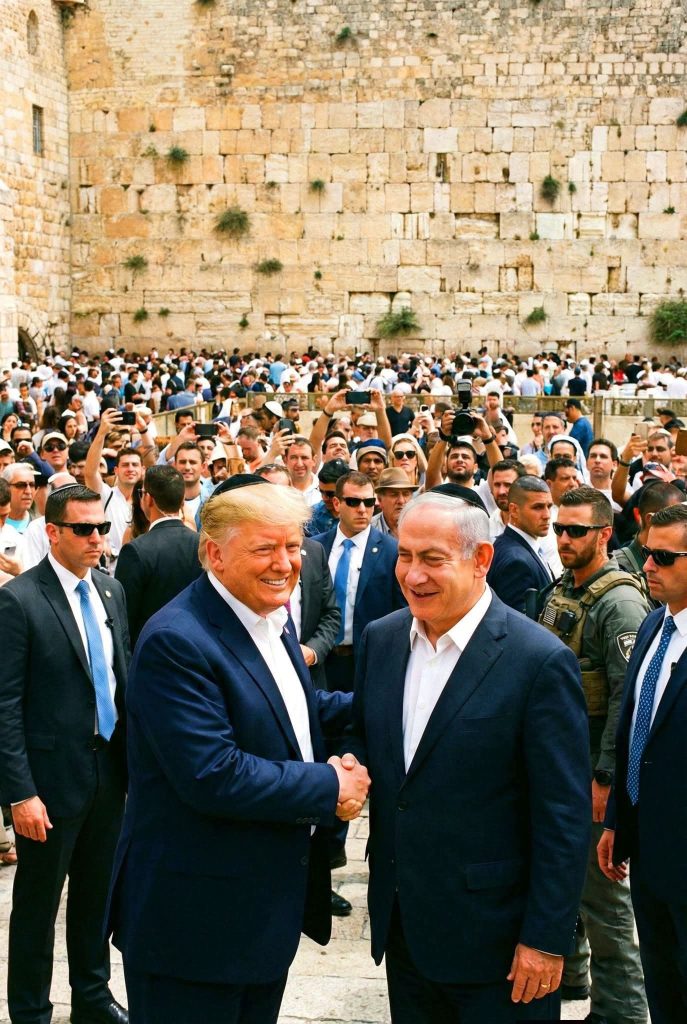
Now we get to the geopolitics—and the part that’s going to make for some very uncomfortable history books.
Whose War Is This?
This war was never America’s war to begin with—it was always Israel’s war. But America has taken ownership of a conflict that was originally Israel’s, and now they can’t give it back.
The Trap Springs Deeper:
Here’s where Trump gets stuck, and the trap closes further by the day:
1. He can’t declare victory. On March 17, Trump described operations as “proceeding very well,” claiming Iran would need “ten years to rebuild the damage” [6]. But the missiles keep flying, the drones keep launching, and the Strait stays closed. As Belarusian analyst Nikolai Platoskin observed: “They are waiting for some kind of capitulation, for Iran to say: ‘That’s it, we give up.’ But they are not giving up” [1].
2. He can’t escalate. The US dropped “multiple 5,000-pound deep penetrator munitions” on Iranian coastal missile sites [2][4][6]. But escalation brings ground troops closer, and ground troops in Iran would make Afghanistan look like a picnic.
3. He can’t withdraw. Withdrawal would signal that American security guarantees mean nothing. But staying means bleeding.
4. He’s been abandoned by allies. Trump demanded that seven countries send warships to help open the Strait. The response was humiliating. Japan, Australia, and South Korea rejected the call [4]. French President Emmanuel Macron stated flatly: “France will never take part in operations to open or liberate the Strait of Hormuz in the current context” [8]. Britain, the only NATO ally who nearly joined, revoked its participation [5]. Trump lashed out at “foolish NATO,” declaring “WE DO NOT NEED THE HELP OF ANYONE!” [2][4][8]
5. His own team is quitting. Joe Kent, director of the National Counterterrorism Center, resigned publicly, citing that he “cannot in good conscience support the ongoing war in Iran” [1]. Trump’s response: “It’s a good thing he’s out. He was very weak on security” [1].
6. Americans are turning against the war. A new NPR/PBS News/Marist poll shows 56% of Americans against the war [8]. Anti-war protests have hit more than 50 US cities. Gasoline prices are at levels not seen since 2020 [1]. “People in the USA are getting furious. They may not care about Iran, but they don’t want to fill up at such a price” [1].
7. The military cost is mounting. The Pentagon confirmed 13 U.S. troops killed and more than 200 wounded [7]. Multiple soldiers suffered severe burns, shrapnel wounds, and traumatic brain injuries [7]. The wounded are spread across seven countries: Bahrain, Iraq, Israel, Jordan, Kuwait, Saudi Arabia, and the UAE [7].
The Israel Factor:Israeli officials say they’ve conducted more than 7,600 air strikes inside Iran. They claim to have killed between 4,000 and 5,000 Iranian military personnel [8]. On March 18, they claimed to have killed Esmail Khatib, Iran’s intelligence minister [3].
But here’s the problem: Israel’s war aims are not America’s war aims. Israel wants regime change. America wants stability and oil prices below $80. Those two things are mutually exclusive.
Russian analysts now report “emerging signs of a possible resumption of direct dialogue between Washington and Tehran” [5]. Meanwhile, Israeli Ambassador to Russia Oded Yosef insists the military operation will continue “as long as it takes” until a leadership pursuing a different political course is formed in Tehran [5].
The USS Tripoli is en route with Marines aboard, suggesting ground options are being prepared [1]. CENTCOM analysts predict a “three-week campaign to methodically take apart” Iranian missile infrastructure [1]. Brett McGurk, former US official, says the US is trying “to uproot the defense industrial base of Iran, to methodically take apart their missile, drone, storage, production – everything” [1].
But as Russian analyst Grigory Lukyanov notes: “Despite severe losses and damage to infrastructure, Iran has retained significant defense capabilities. Even following strikes on military facilities, infrastructure and command structures, the Islamic Republic still has quite an ample arsenal for continued hostilities” [5].
VII. THE PAKISTAN POSITION: From Tightrope to Goldmine
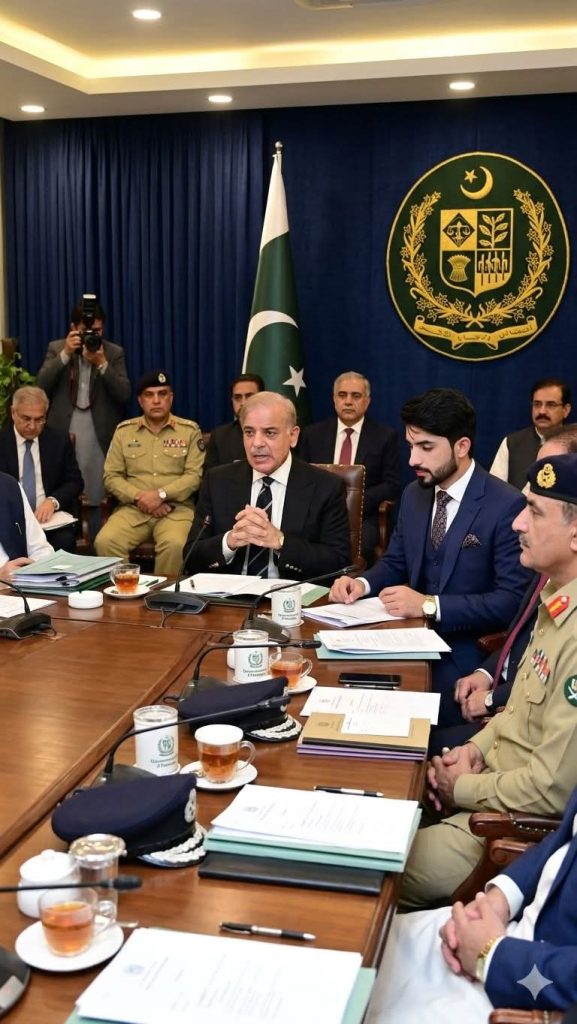
Every country in the region is being forced to choose sides. Except one.
Pakistan finds itself in an unprecedented position—it’s the only major player maintaining working relationships with Washington, Tehran, Riyadh, Beijing, Moscow, and Ankara simultaneously [9]. But here’s what the analysts are missing: this isn’t just diplomatic survival. This is a $20-25 billion opportunity wearing a camouflage uniform.
The Paradox of March 18:
While Gulf oil terminals burn and global shipping grinds to a halt, Pakistan’s finance ministry quietly released numbers that would be impossible to believe if they weren’t on official letterhead. A $427 million current account surplus**—the largest since March 2025 [4]. FDI up **24 percent month-on-month** [4]. Remittances climbing **11 percent year-on-year** [4]. IT exports touching **$365 million in a single month [4]. Foreign reserves at a four-year high, touching $21.6 billion [4][5][10].
This is the paradox of the Hormuz war: the same chaos that is bankrupting Gulf states is, for the moment, making Pakistan look like the stable cousin.
The Naval Opening:
Pakistan’s Navy has quietly positioned itself as a guarantor of maritime security. While Iranian missiles forced Dubai airport to evacuate and set Fujairah’s oil zone ablaze, Pakistani-flagged vessels were among those permitted to transit the Strait [9]. Not because Iran is generous. Because Tehran knows Islamabad has leverage—and because Pakistan positioned itself as the honest broker before the shooting started.
Information Minister Attaullah Tarar made it official on March 18: “Pakistan is ready to play its role in de-escalating the tensions in the Middle East” [9]. Speaking to Al Jazeera, Tarar emphasized Pakistan’s “pivotal role as a regional partner with a deep commitment to diplomatic stability” and confirmed Islamabad is “involved in talking with various partners” to mediate [9].
The $25 Billion Question:
Defence analysts are now openly discussing Pakistan’s potential defence export pipeline, estimated at $13-15 billion in active negotiations**, potentially reaching **$20-25 billion over the medium term . These aren’t small-ticket sales. They include:
· A reported $4 billion comprehensive defence package with the Libyan National Army ·
A $1.5 billion deal with Sudan for 10 Karakoram-8 aircraft, 200+ drones, and advanced air defence systems
· Ongoing negotiations with Saudi Arabia, Qatar, Egypt, Indonesia, Bangladesh, Iraq, and Azerbaijan
The Saudi dimension is particularly significant. Reports suggest defence partnerships with Riyadh could expand into a trilateral framework involving Turkey and Qatar, potentially eclipsing headline figures attached to other contracts.
The JF-17 Dividend:
Every missile that flies over Hormuz is a marketing video for Pakistani defence exports. The JF-17 Block III proved its cost-effectiveness against Indian jets in 2025. Now Gulf states watching Iranian drones humiliate American air defences are asking a simple question: “Who builds affordable, effective systems without Western strings attached?”
The answer is Islamabad.
But Here’s the Nightmare Scenario:
The same geography that creates opportunity also creates existential risk. On March 18, another Pakistani national was killed in Abu Dhabi by debris from an intercepted missile [4]. An Iranian projectile struck near Al Minhad Air Base in the UAE, where Australian forces are stationed—this base is 30 minutes from Dubai [2]. 81% of Pakistan’s oil imports transit the Strait of Hormuz; any sustained closure hits hard. Half of Pakistan’s $38.3 billion annual remittance inflow comes from the Gulf [4].
Defence Minister Khawaja Asif laid it out bluntly: in the event of regime change in Iran, the “joint single point agenda of Afghanistan, Iran, and India will then be enmity towards Pakistan” [1]. A hostile arc from the Persian Gulf to the Bay of Bengal. A two-front war with nuclear neighbors on both sides. Pakistan reduced to a “vassal state” [1].
This isn’t paranoia. It’s arithmetic.
The Afghanistan Time Bomb:
On March 16, Pakistan’s UN Ambassador Usman Jadoon told the Security Council what Islamabad has been screaming for years: terrorism from Afghan soil is rising “exponentially” [UN record]. Elements within the Taliban regime are “actively collaborating” or providing a “permissive environment” to the TTP, BLA, Majeed Brigade, Daesh-K, Al Qaeda, and ETIM. These groups operate with impunity, targeting Pakistani civilians, law enforcement, and critical infrastructure.
The UN Security Council resolution, which Pakistan supported, calls on the Taliban to take “immediate, demonstrable and concrete measures” against terrorism. But everyone knows what that means: nothing. Kabul has made multiple commitments. All have been broken. The peace talks failed not because Pakistan didn’t engage, but because Afghanistan’s commitments were never real.
Ambassador Jadoon also flagged India’s role as a “spoiler” in Afghanistan, warning that New Delhi has “long played this dangerous game” of stoking terrorism inside Pakistan from Afghan soil.
The Kabul Strike: Separating Propaganda from Reality
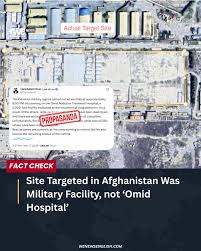
On March 16, Afghan Taliban officials claimed Pakistani airstrikes killed over 400 people at “Omid Hospital,” described as a drug rehabilitation center in Kabul . The numbers—400 dead, 250 injured—went viral. But within 24 hours, the narrative collapsed.
Pakistan’s Ministry of Information and Broadcasting issued a detailed fact-check: the targeted site was not Omid Hospital but a military facility several kilometers away from the actual medical center . Satellite imagery shows the real Omid Hospital is a multi-story building; the strike site consisted of containers and temporary structures containing weapons and explosives . The Afghan Taliban’s official post and video were quietly deleted—no explanation, no retraction. Pakistan’s fact-checking unit flagged the footage as possibly AI-generated, unable to withstand independent scrutiny . The lesson for Islamabad’s position: in an information war, the side that deletes its evidence loses credibility.
The Taliban’s Sudden Pivot
On March 18, in a joint announcement brokered by Saudi Arabia, Qatar, and Turkey, Pakistan and the Afghan Taliban declared an Eid ceasefire—a halt to military operations from March 19-23 . Information Minister Attaullah Tarar framed it carefully: “Out of goodwill and following Islamic traditions, the government will suspend military operations. However, if any cross-border attack, drone incursion, or terrorist incident occurs inside Pakistan, operations will resume immediately—with greater intensity” . The Taliban’s spokesman Zabihullah Mujahid, for the first time, stated that “defending Afghanistan is a national and religious duty” and that Afghanistan would respond to any aggression or threat—but significantly, he did not repeat previous denials of TTP presence on Afghan soil . Whether this represents a genuine shift or tactical breathing room remains to be tested.The Saudi Initiative and Regional Requests
On March 18, Pakistan joined foreign ministers from 10 Muslim nations in Riyadh for a consultative meeting convened by Saudi Arabia, aimed at enhancing coordination on regional security and stability . The agenda focused on Iran’s continuing attacks on Gulf states, self-defense coordination, and diplomatic resolution. Deputy Prime Minister Ishaq Dar arrived in Riyadh carrying Islamabad’s dual message: condemnation of attacks on Gulf sovereignty and readiness to mediate . Multiple Middle Eastern countries—including Saudi Arabia, Qatar, and Turkey—have formally requested Pakistan’s continued engagement, recognizing its unique ability to maintain channels with Tehran, Washington, and Gulf capitals simultaneously while the rest of the region chooses sides .
The India Factor:
India’s regional clout has taken hits. Chafed by US claims of decisive American intervention in the 2025 conflict, shaken by military hardware losses, and facing worsening relationships with smaller neighbors, the BJP finds itself on the regional back foot. The reflexive temptation will be to look for external wins.
The threshold for crisis initiation between India and Pakistan is now dangerously low. Any unrest in Indian-held Kashmir could be invoked as justification to resume hostilities.
The Bottom Line on Pakistan:
Pakistan isn’t the region’s savior. It’s a country with deep vulnerabilities trying to keep its head down while the neighborhood burns. Its leverage comes not from ambition but from necessity—everyone needs someone who can still pick up the phone.
But the paradox of March 18 is real: while Gulf oil terminals burn, Pakistan’s economy quietly strengthens. The adviser to the finance minister knows what everyone in Rawalpindi knows: oil at $102 is a reprieve, not a cure. The real test comes when the shooting stops and the region calculates who owes what to whom.
VIII. THE GCC SHIFT: America’s Gulf Allies Are Having Second Thoughts
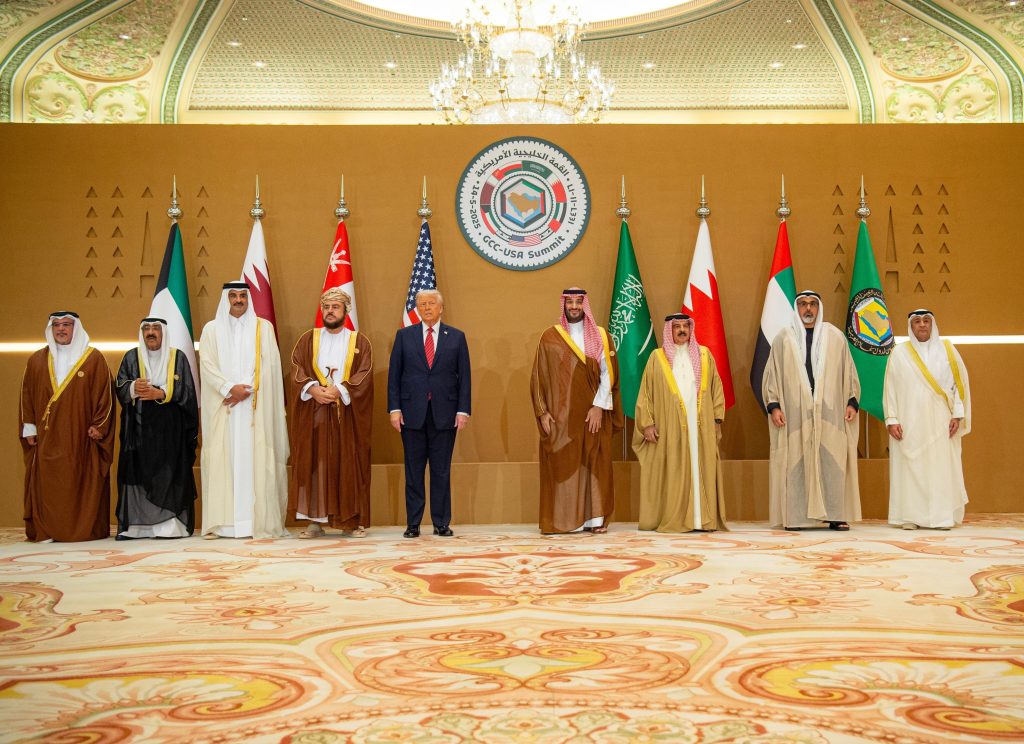
Here’s the development that keeps CENTCOM commanders awake at night:
The Gulf Cooperation Council states—Saudi Arabia, UAE, Qatar, Kuwait, Bahrain, Oman—are caught between anger at Iran and dismay at the United States.
The Anger at Iran:
Iran has expended huge diplomatic effort in the past two years trying to convince Gulf states that Israel, not Iran, is the chief destabilizing force in the region. Much of that work has been destroyed in days.
On March 18 alone, Iran attacked:
· Saudi Arabia’s Eastern Province (oil fields) [2][3][4]
· Kuwait (rocket and drone strikes) [4]
· Bahrain [2]·
Qatar [2]
· UAE (Al Minhad Air Base, Dubai) [2][4]
The UAE has borne the brunt. Officials now report 7 people killed and 145 injured since the war began [1][2]. Dubai airport briefly shut down [5]. Fujairah faced its third attack in four days [4].
But Also Dismay at the US:
One Saudi official complained early in the war: “The United States abandoned the Gulf states and redirected its air defence to protect Israel.” That sentiment hasn’t faded.
On March 18, Saudi Arabia shot down a ballistic missile targeting Prince Sultan Air Base (which hosts American forces) and two drones targeting Riyadh’s diplomatic quarter (which houses the U.S. Embassy) [2]. Kuwait’s air defenses responded to attacks [4]. Qatar’s defenses were active [2].
The message is clear: Gulf states are defending themselves. The US air defense assets went to Israel. They’re on their own.
The GCC Response:
Saudi Arabia will host a consultative meeting of foreign ministers from Arab and Islamic countries in Riyadh on March 18 evening to discuss ways to support regional security and stability [9]. But the question lingers: coordinated action with whom? The US, after being left exposed? Or are Gulf states quietly reconsidering their security arrangements?
IX. THE FAKE NEWS SEGREGATION:

How to Watch This War Without Getting Brain Damage
A mandatory interlude on information warfare—because if you’re consuming this conflict through official statements alone, you’re not just missing the story.
You’re being played.
The Number Game: Everyone Lies
Let’s state the obvious: in any war, the first casualty is truth. This war is no exception. Every single actor is filtering, spinning, and flat-out fabricating numbers to serve their narrative.
Israel’s Numbers: Built for Domestic Consumption
Israeli officials claim they’ve killed Ali Larijani, Gholam Reza Soleimani, and Esmail Khatib (intelligence minister) [3]. The first two are confirmed by Iranian sources. The third? Unclear.
They claim 4,000-5,000 Iranian military killed [8]. Even if accurate—and that’s a significant ‘if’—that represents less than 1% of Iran’s 610,000 active personnel and 350,000 reservists . The IRGC’s Aerospace Force, which controls the missiles, numbers in the tens of thousands. Attrition is real, but Iran’s manpower depth means it can absorb losses that would cripple smaller militaries. The real constraint isn’t bodies—it’s launchers. And with 60-75% of Iran’s 400-550 launchers reportedly destroyed , the bottleneck isn’t who can push the button, but whether there’s anything left to push it from.
.Iran’s Numbers: Resistance Propaganda
Iran’s state media claims 3,200 U.S. casualties in the first week—200 killed, 3,000 injured [3]. The official also claimed 150 U.S. missiles, 23 Patriot systems, and 37 aircraft destroyed [3]. The Pentagon admits 13 killed and 200+ wounded [7]. The truth is somewhere in between.
Iran also claims 1,332+ civilians killed [4]. The Iranian Red Crescent confirms over 1,300 [2]. A judiciary complex in Larestan was hit during working hours, killing staff and civilians—exact numbers unknown [2].
US Numbers: The Fog of War Plus Politics
Trump claims Iran’s air force and navy are destroyed, that it would take a decade to rebuild [6]. Yet Iran launched multi-warhead missiles at Tel Aviv on March 18 [2]. The Pentagon admits 13 killed, 200+ wounded [7]. An Iranian official claims 43% of Iran’s stockpile is gone—which means 57% remains [3].
GCC Numbers: Self-Preservation Statistics
The UAE reports 7 killed [1][2]. Kuwait reports 6. Saudi Arabia reports 2. These are almost certainly undercounts. Gulf monarchies have a vested interest in minimizing domestic panic.
The One Number That Doesn’t Lie:
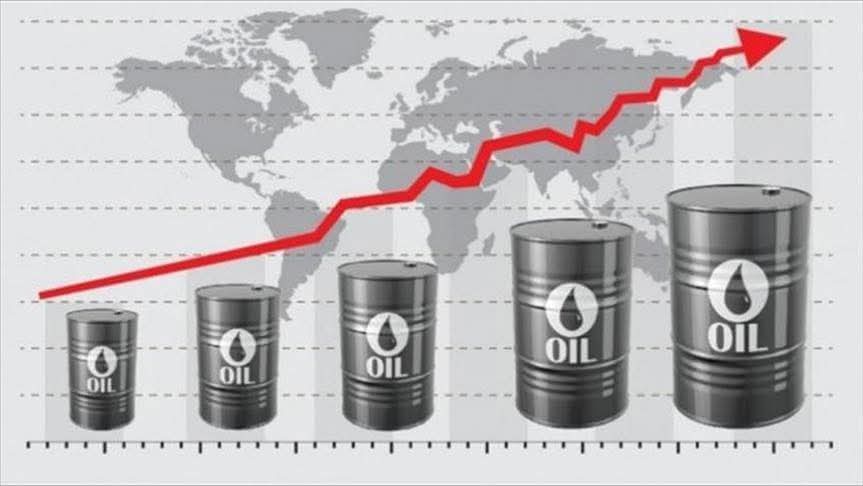
Oil prices. Brent at $102. Up 40% since the war began. That’s not propaganda. That’s the market pricing in risk.
The Segregation Protocol:
Fake News: “Israel eliminated Iran’s ability to strike.”
Real News: Iran launched multi-warhead missiles at Tel Aviv on March 18 [2].
Fake News: “The Strait will reopen soon.”
Real News: Iran’s parliament speaker says it “won’t return to its pre-war status” [2][5].
Fake News: “Allies are joining the coalition.”
Real News: Japan, Australia, South Korea said no. France said never. Britain backed out [4][5][8].
Fake News: “Iran’s leadership is collapsing.”
Real News: The new Supreme Leader rejected ceasefire overtures and demanded compensation [9]. CGTN reports: “Tehran’s resilience stems from the clerical establishment’s unexpected resilience. Despite sustained strikes across the Islamic Republic, there have been no major defections or fractures within the leadership” [10].
The Golden Rule of War Coverage:
Follow the oil prices, not the press releases. Oil doesn’t lie. And right now, oil is screaming that this war is far from over.
X. THE AI BATTLEFIELD: Where Warfare Is Headed
We can’t talk about precision warfare without talking about where it’s going. And where it’s going is algorithmic warfare.
What Iran Is Doing Now:
Iran’s current approach is impressive but not AI-driven. They’re using BeiDou for guidance. They’re using pre-programmed waypoints. They’re using human operators for targeting decisions. The “swarm” tactics are coordinated but not autonomous.
What’s Coming:
The next generation of warfare will look different. China’s PLA Daily has published analyses on “Empowering National Defense Mobilization with Generative AI.” The concepts include:
· Predictive logistics: AI analyzing consumption patterns to predict what units need, where, and when
· Autonomous targeting: Systems that identify enemy patterns, predict commander behavior, and generate optimal strike packages
· Swarm coordination: AI managing hundreds of drones simultaneously, adapting in real-time to enemy countermeasures
· Decoy generation: AI creating convincing fake targets to saturate enemy air defenses
The Dangers:
The same analyses warn of “data poisoning” and “model theft”—enemies feeding false data to corrupt AI decision-making. The next war won’t just be missiles versus missiles. It will be algorithms versus algorithms, training data versus training data.
The Lesson:
Iran has leapfrogged one generation by integrating Chinese satellite guidance. The lesson for smaller powers: you don’t need to build the iPhone. You just need to buy one. The next lesson will be about buying the AI that guides the missiles.
XI. THE CASUALTY COUNT: The Human Cost Nobody Knows
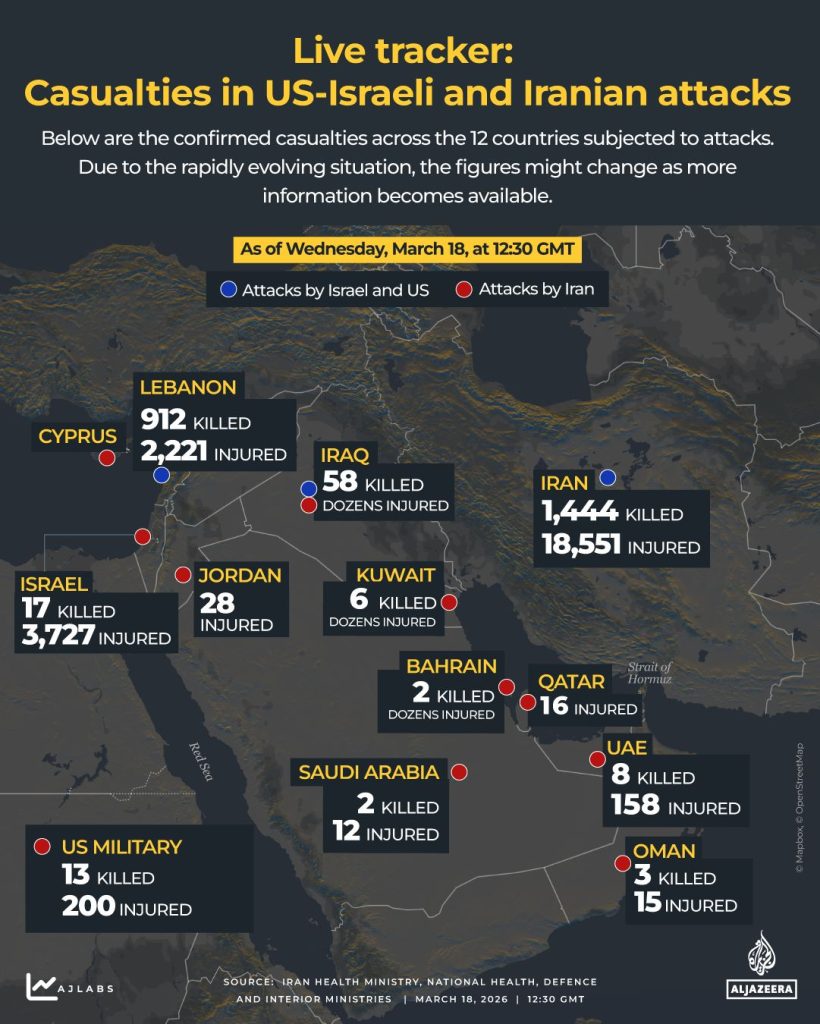
Let’s pause on the numbers, with the massive caveat that every single one of these numbers is filtered, spun, and weaponized by the country releasing it.
According to various official reports compiled from state media and government statements [1][2][3][4][7]:
Country/Category Casualties Source
Iran (civilian) 1,332+ killed Iranian officials [4]Iran (total killed) Over 1,300 Iranian Red Crescent [2]
Iran (wounded) 10,000+ Iranian health officials [8]
Iran (displaced) 3.2 million UNHCR [8]
Israel 14+ killed Israeli authorities [9]
United States 13 killed, 200+ wounded Pentagon [7]
UAE 7 killed, 145 injured UAE officials [1][2]
Kuwait 6 killed Kuwaiti officials
Saudi Arabia 2 killed Saudi officials
Bahrain 2 killed Bahraini officials
Oman 2 killed Omani officials
Syria 4 killed Syrian officials
France 1 soldier killed French military
Pakistan 3+ killed (latest March 18) UAE/Pakistan officials [4]
Iranian military losses:
Israel claims 4,000-5,000. Iran doesn’t release figures. An Iranian official claimed 43% of stockpile destroyed—which implies significant military losses [3].
Civilian infrastructure: Over 61,000 civilian units damaged, per Iranian officials [1][7].
The One Certainty:
The only thing we know for sure about these numbers is that they’re all wrong. Not intentionally wrong in every case—some are good-faith estimates. But wrong nonetheless.
XII. THE ENDGAME: Four Scenarios, Only One Plausible
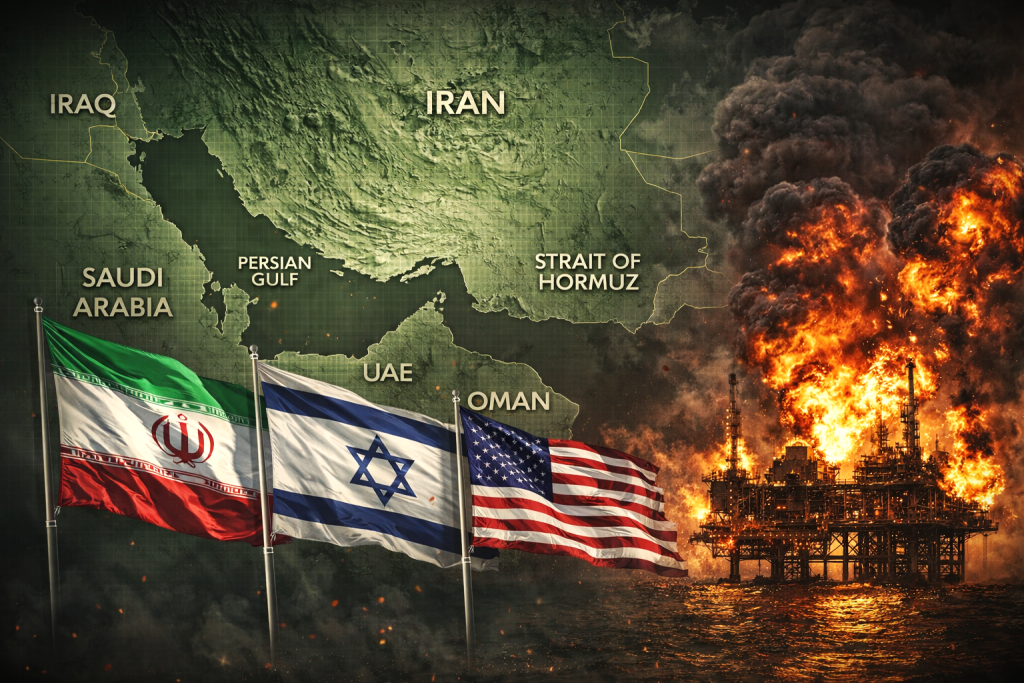
So where are we going? Let’s game this out realistically.
Scenario 1: Trump Finds an Off-Ramp (Now 45-50% probability)
This was the most likely outcome a week ago. But Larijani’s death changes everything. “With his death, the exit route is virtually shut” [5]. The new Supreme Leader has rejected all ceasefire overtures, demanding US/Israel “admit defeat and pay compensation” first [9]. Iran’s position has hardened, not softened.
Russian analyst Ivan Loshkarev notes: “A scenario where the United States itself will take the first steps toward de-escalation appears more likely. Rising fuel prices, skepticism from a significant part of society, including Republicans, as well as the upcoming midterm election campaign may put pressure on Washington” [5]. But Iran must be willing to meet halfway. So far, they’re not.
Scenario 2: The Long War (Now 45% probability)
This probability has increased significantly. The US is dropping 5,000-pound bunker busters [2][4][6]. Marines are en route (USS Tripoli) [1]. CENTCOM analysts predict a “three-week campaign to methodically take apart” Iranian missile infrastructure [1]. Israel says it will continue “as long as it takes” [5].
J.P. Morgan warns Gulf states have “no more than 25 days” of output [4]. If this stretches past that, global recession follows.
Iran, meanwhile, believes it can win a war of attrition. CGTN’s analysis is worth quoting at length:
“At the heart of Iran’s approach is a deliberate war of attrition. Tehran believes it can absorb and outlast the costs longer than its adversaries for several structural reasons. First, years of sanctions have conditioned both the economy and society to endure prolonged hardship. Second, Iran’s large territory, dispersed population and asymmetric capabilities – cheaper missiles and drones as well as allied groups across the region – allow it to stretch out the conflict without needing to match US or Israeli conventional firepower. Third, Tehran’s approach is grounded in the belief that Washington’s decisions are constrained by electoral cycles and public opinion, while Israel’s economy and reservist system face mounting strain from extended operations” [10].
Scenario 3: Gulf States Turn on Iran (5% probability)
The GCC, fed up with being hit, joins the US coalition more openly. This would represent a massive strategic defeat for Iran. But it’s increasingly unlikely. Gulf states have watched US air defenses protect Israel while Iranian missiles hit their soil. The message: the US will protect itself and Israel first, Gulf allies second. Why sign up for more?
Scenario 4: Iranian Regime Collapse (Less than 1% probability)
This is what Israel wants. But CGTN reports: “Tehran’s growing confidence in the conflict stems from the clerical establishment’s unexpected resilience. Despite sustained strikes across the Islamic Republic, there have been no major defections or fractures within the leadership, while the Revolutionary Guards and other core institutions continue to maintain tight control nationwide” [10].
Russian analyst Grigory Lukyanov: “Despite severe losses and damage to infrastructure, Iran has retained significant defense capabilities” [5].
The Most Likely Outcome:
The US and Israel are now in a grinding war of attrition with no clear exit. Iran has shown it can absorb punishment and keep fighting. The new Supreme Leader has shown no interest in compromise. Larijani, the pragmatist who might have negotiated, is dead.
Trita Parsi’s three takeaways:
1. Israel is systematically eliminating Iran’s pragmatists
2. Regime implosion has returned as an objective
3. Israel acts regardless of diplomatic consequences [5]
The war, as of now, has no exit [1].
XIII. THE BOTTOM LINE: Who Actually Won?
Let’s be honest about what this war has accomplished.
Iran:
The regime survived. The leadership transition happened without collapse. The missile forces proved they can hit Tel Aviv with multi-warhead cluster munitions [2]. The drone program demonstrated its cost-effectiveness. The Strait closure showed that Iran can control the world’s most important waterway.
But Iran is battered. Kharg Island is damaged. The economy is worse. Casualties are real. The Gulf states that were warming to Tehran are now hostile again.
Israel:
Israel proved it can strike deep inside Iran. It killed the Supreme Leader, the security chief, the Basij commander [2][3]. It damaged nuclear facilities.
But Israel also demonstrated that military superiority doesn’t translate into strategic victory. The missiles kept coming. The drones kept flying. Fragments of Iranian missiles were found near the Al-Aqsa Mosque and Church of the Holy Sepulchre in Jerusalem [1][10]. Iran’s new leadership is more hardline, not less. Israel’s war aims—regime change, nuclear destruction—remain unachieved.
United States:
America showed it can project power. It can drop 5,000-pound bombs. It can protect Israel.
But America also showed it can’t protect its Gulf allies. It can’t control escalation. It can’t force a decisive outcome. It can’t leave without losing credibility. And it can’t stay without bleeding politically. Thirteen dead. Two hundred wounded. Allies refusing to help. Gas prices at $3.63. Fifty-six percent of Americans opposed.
The unipolar moment is over. A mid-tier power with smart strategy, cheap drones, underground factories, and Chinese satellites bloodied a superpower and survived.
The GCC:
The Gulf states learned that American security guarantees are conditional. When the missiles flew, the air defenses went to Israel. The message was received. The search for alternative security arrangements will accelerate.
Pakistan:
Pakistan learned that its worst nightmare—a hostile Iran on one border and a hostile India on the other—is closer than ever. It also learned that being able to talk to everyone is a survival mechanism. And it learned that while Gulf oil terminals burn, its own economy can quietly strengthen—at least for now.
The Real Winner:
There is none. This is a war of mutual exhaustion. Everyone loses something. The only question is who loses less.
EPILOGUE: What Comes Next
After this war—however it ends, whenever it ends—the Middle East will not go back to the old order.
The GCC will never fully trust American security guarantees again. Why would they? The US air defense assets went to Israel while Iranian missiles hit their soil. The message was received. Gulf states will diversify their security partnerships. China will be waiting.
China will have a permanent foothold in Gulf defense architecture. BeiDou isn’t going away. The 25-year strategic partnership with Iran isn’t going away.
Russia will have re-established itself as an energy power broker and diplomatic player. Sanctions are bending. Oil revenue is flowing.
And Iran will have demonstrated that a mid-tier power can bloody a superpower and survive. The regime is battered. The economy is worse. But the flag still flies in Tehran. The Revolutionary Guard is still in power. And on March 18, Iranian missiles forced Dubai airport to evacuate, struck Tel Aviv with cluster munitions, and hit oil infrastructure across the Gulf [2][4][10].
On March 18, Iranian Parliament Speaker Mohammad-Bagher Ghalibaf declared: “The Strait of Hormuz won’t return to its pre-war status” [2][5].
On March 18, the new Supreme Leader rejected all ceasefire overtures [9].
On March 18, Larijani’s body was being buried while his killers calculated the cost of a war that has no end in sight.
It ended with a multi-warhead missile—releasing cluster munitions over Tel Aviv while generals in every capital did the math and realized that the old rules no longer apply.
The age of unipolar American dominance didn’t end with a bang. It didn’t even end with a whimper.
That’s the new Middle East. Welcome to it.